
Supplychaingame: experience the bullwhip effect first-hand
The Supplychaingame is our further development of the MIT Beer Game, created in the early 1960s by Jay Forrester's System Dynamics group. Each group takes over one tier of a supply chain and makes exactly one decision week after week: how much do I order? Deliveries and orders take time, and at first each tier only sees its own figures. A single increase in customer demand is enough to make the whole chain oscillate.
- Target group
- first-semester bachelor to master's students, professional and corporate training
- Duration
- one session (90 min), half a day, or as a semester exercise
- Group size
- up to 10 chains with 1–5 tiers, 1–4 people per tier, or solo
- Game length
- 15 periods by default, adjustable up to 50
- Technology
- in the browser, no installation, also on mobile; German and English
- Preparation
- about 15 minutes for the first game
What your participants learn
Bullwhip effect
How small changes in demand build up along the chain – and what causes this.
Systems thinking
Delays and feedback: why well-intended decisions create fluctuations.
Inventory management
Inventory position instead of stock on hand: keep goods in transit and open orders in mind.
Newsvendor model
Critical ratio, safety stock and order-up-to level – testing theory against your own figures.
Information and collaboration
What changes when everyone can see everything or is allowed to talk?
Trade-offs and costs
Holding costs versus shortage costs, your own result versus that of the whole chain.
Experience at MIT shows how large the effect is: on average, teams' costs were about ten times the optimum. In one of our sample games, the producer's orders fluctuated ten times as much as customer demand (bullwhip factor 10.1).
Source for the cost figure: John Sterman, MIT System Dynamics Group; Sterman (1989), Management Science 35(3).
More than the original
All extensions are optional. With the default settings you play the classic Beer Game.
Price and contribution margin
The customer pays per unit; revenue is shared equally. A price of 0 corresponds to the original.
Chain to measure
1–5 tiers, freely adjustable shipping and order delays.
Control demand
Classic 4 → 8, constant or random with μ and σ, each period adjustable.
Any industry
Rename product and tiers: pharmaceutical plant instead of brewery, aspirin instead of beer.
Transparency switch
See only your own tier as in the original – or the whole chain.
Competing chains
Up to 10 chains with the same demand, ranked by profit.
Solo with computer partners
Three behaviour patterns, a story for each template, a leaderboard.
One-click analysis
Bullwhip factor per tier, charts and CSV export for Excel.
One game – from first semester to master's level
Introductory
Bachelor, training courses
- classic settings
- demand 4 → 8
- focus: experience and explain the bullwhip
- 15 periods
Advanced
Bachelor from 3rd semester
- random demand with μ and σ
- price > 0, contribution margin
- second round with transparency
- 15–25 periods
Expert
Master, executive education
- newsvendor and order-up-to level
- compare computer partners
- CSV analysis, variance ratio
- up to 50 periods
Course formats
One session
Introduction to SCM, logistics lecture, corporate training.
Half a day
Experiment: classic versus transparency or shorter shipping delay.
Semester exercise
Newsvendor and order-up-to level as an assignment, with a leaderboard as an incentive.
Online and hybrid
Live status lights and chat per chain; the moderator can write to everyone.
Example: one 90-minute session
| Time | Content | Goal |
|---|---|---|
| 0:00 | Introduction with the participant slides, assign tiers, hand out login details | Understand the idea and rules |
| 0:15 | Read period 0, place the first order – without time pressure | Get to know the cockpit |
| 0:25 | Periods 1–15, about 2 minutes per period, automatic calculation | Decide under delays |
| 1:00 | Teams estimate: what did customer demand look like? | Perception and reality |
| 1:05 | Show the analysis: orders per tier, bullwhip factor, costs | Make the bullwhip visible |
| 1:15 | Debriefing: causes and remedies | Secure the insights |
The moderator package also contains a half-day schedule with an experiment, debriefing questions with answers and suggestions for assessments.
A look at the lecturer slides
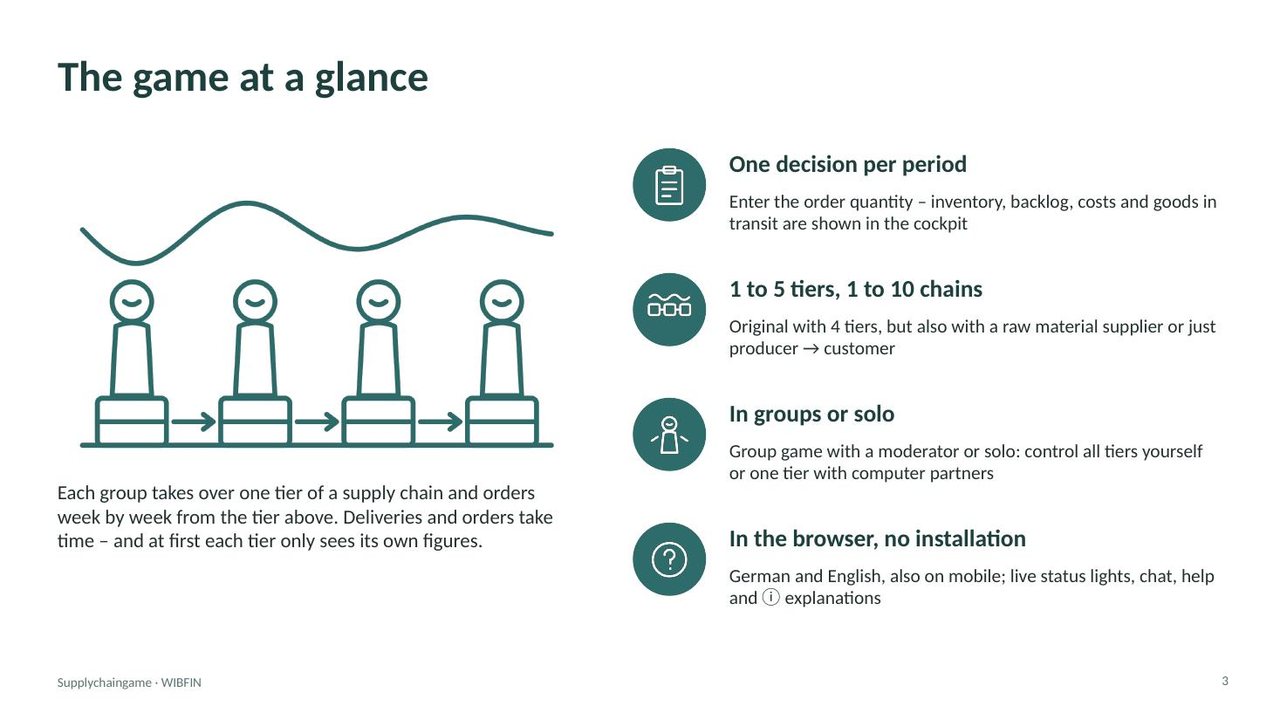
Selected slides from the 23-slide lecturer deck. The screenshots show the game's German interface; the game itself can be played in German and English.
Materials
Introduction for participants
14 slides to get started: mission, supply chain, what happens in a week, costs and goal, cockpit, rules and five tips. Show them at the start or hand them out for preparation. Fields in square brackets (event, rules, grading) are completed by the moderator.
View PDF PDF, 0.9 MBSolo game
Play it yourself first: control all four tiers, run one tier with computer partners, or try the newsvendor model. Signing in with a name and password is all it takes.
Go to SupplychaingameModerator package
- Moderator access: set up games, run them live, analyse results
- "Teaching concept" slide deck (23 slides) with speaker notes
- Schedules, debriefing questions with answers, assessment formats
- Participant introduction as an editable PowerPoint file