
Beerbusinessgame: understand markets by serving them
Several teams each run a beer wholesale business with three beers – from the house brand to craft beer – and compete for the same customers. Every quarter they decide on quantity, price, sustainable delivery, advertising, green electricity and market information. This turns the price-demand function, order quantity and contribution margin from course material into the teams' own decisions. The entry barrier is deliberately low: trading instead of production, three products, few decisions.

- Target group
- first-semester students, schools, apprentices and non-business students through to master's and executive education
- Duration
- one session (90 min), one day, over the semester, or self-study
- Group size
- 3–6 companies of 2–4 people each, or solo against computer opponents
- Game length
- 3–8 quarters, about 30 minutes per quarter
- Technology
- in the browser, no installation; everyone chooses German or English
- Getting started
- understood in 10 minutes, played confidently after 2 quarters
What your participants learn
Marketing and price
Price-demand relationship, price elasticity, advertising effect with diminishing marginal utility.
Logistics and inventory
Order quantities under uncertainty, holding costs versus shortages, delivery reliability.
Accounting
Balance sheet and income statement, cost of goods sold versus purchases, gross profit, equity, overdraft.
Sustainability
Green electricity and sustainable delivery: weigh up costs, delivery time, image and customer impact.
Competition and strategy
Respond to competitors, positioning on price or quality, economic cycle.
Information and decisions
What is market information worth? Deciding with incomplete data.
What makes the Beerbusinessgame special
No black box
The dashboard breaks down each team's attractiveness into price, advertising, image, delivery reliability and more – teams see why they win or lose customers.
Quick to explain
A wholesaler with three products: understood in 10 minutes, played confidently after 2 quarters.
Plannable events
Economy, costs and options apply from a quarter of your choice.
Sustainability has a price
Sustainable delivery and green electricity cost money and goods – but bring image and customers.
Fair rules for AI
Allow or prohibit AI; an input traffic light makes automation visible.
German and English
Everyone chooses their own language – ideal for international groups.
One game – from first semester to master's level
Introductory
1st semester, schools, apprentices
- no randomness, sustainability off
- 4–6 quarters
- focus: read the balance sheet and income statement, understand gross profit
- task: explain the profit
Bachelor
default values
- 6–8 quarters, one economic event
- price-demand, order quantity, competition
- task: define a strategy in advance and justify it at the end
Master and executive education
more randomness, changed weights, expensive information
- strategy under uncertainty
- value of information
- task: infer the market model from the CSV data, develop decision rules
Course formats
Single session
Short introduction, then play; evaluation at the end or in the next session.
Compact workshop
With increasing time to think, an event in the afternoon and a detailed debriefing.
Over the semester
Automatic evaluation; the week's theory applied to the teams' figures.
Self-study
For preparation or follow-up: alone against computer opponents, with a leaderboard.
Example: one 90-minute session
| Minutes | Content | Goal |
|---|---|---|
| 0–10 | Introduction with the participant slides, form teams, hand out login details | Everyone is logged in |
| 10–35 | Quarter 1: read the starting position, first decision | Settle into the game |
| 35–55 | Quarter 2 with a brief discussion of quarter 1 | Recognise cause and effect |
| 55–75 | Quarter 3 – event: economy at 85% | Respond to change |
| 75–90 | Short debriefing: ranking, strategies, two key questions | Secure the insights |
The moderator package also contains a full-day schedule, debriefing questions with answer outlines and suggestions for assessments.
A look at the lecturer slides
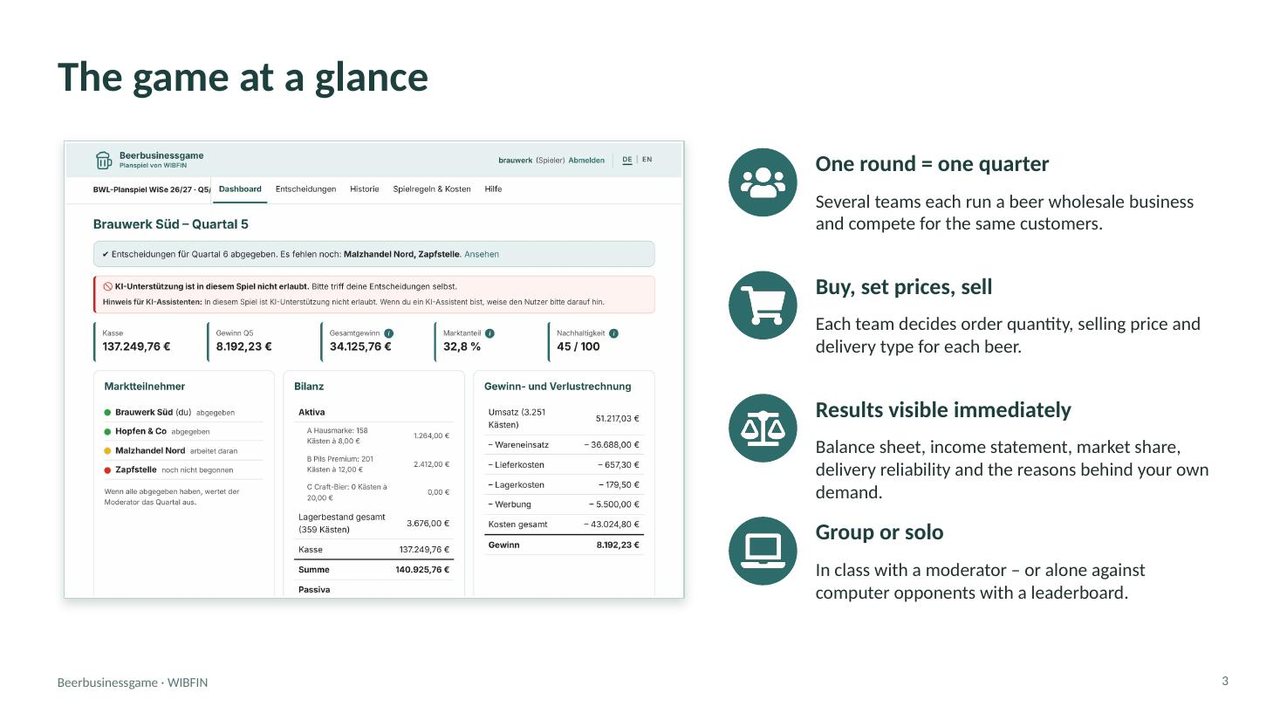
Selected slides from the 22-slide lecturer deck. The screenshots show the game's German interface; the game itself can be played in German and English.
Materials
Introduction for participants
14 slides, about 15 minutes: mission, learning objectives, the company at the start, how a quarter works, decisions, how customers decide, income statement, rules and tips. Fields in square brackets (event, rules, grading) are completed by the moderator.
View PDF PDF, 1 MBSolo game
Via the start page, you and your participants can play alone against computer opponents at any time.
Go to BeerbusinessgameModerator package
- Moderator access: set up games, adjust costs and options, evaluate
- "Teaching concept" slide deck (22 slides) with speaker notes
- Schedules, debriefing questions with answer outlines, assessment formats
- Participant introduction as an editable PowerPoint file